
A practical guide for commercial property owners | EMG Building Solutions
An aging metal roof does not always need to be torn off. But it does need an honest evaluation before anyone promises that a new coating will solve its problems. On commercial buildings, the right decision often comes down to the condition of the metal, the source of the leaks, drainage, and whether the existing roof can safely support a new assembly.
One option worth understanding is a flute-filled TPO recover system: a new single-ply roof installed over a suitable existing metal roof. It is not the right answer for every building, but in some situations it offers a more comprehensive approach than applying a coating over recurring problem areas.
What goes wrong with aging metal roofs?
Metal roofing systems can develop corrosion, loose or deteriorated fasteners, failing sealants, movement at seams, and leaks around penetrations. When the roof has a shallow slope or poor drainage, those vulnerabilities become even more important. A leak may appear at one spot indoors even though water is entering somewhere else along a seam or flashing detail.
Before choosing any restoration method, a contractor should investigate the roof’s condition, locate moisture intrusion, evaluate drainage, and determine whether damaged panels or structural components require repair or replacement.
When does a roof coating make sense—and when does it not?
Roof coatings have legitimate uses. On a properly prepared, compatible, and sound roof, an appropriate coating system may extend service life and improve reflectivity. However, coatings are not a substitute for repairing failed seams, corrosion, trapped moisture, or structural deterioration. Preparation and the specific product’s limitations matter.
From the field perspective behind this article, repeatedly coating a rusted, leak-prone metal roof without correcting the underlying defects is not a recommendation EMG Building Solutions wants to make. A fresh surface may look reassuring, but appearance alone does not establish that the roof is watertight.
Ponding water also needs careful attention. Some coatings are rated for standing-water exposure and others are not. Neither a coating nor a new membrane should be treated as a way to ignore drainage defects.
What is a flute-filled TPO recover system?
TPO stands for thermoplastic polyolefin, a single-ply roofing membrane whose overlapping seams are joined by hot-air welding. In a metal roof recover, the existing metal panels may remain in place after the roof and supporting structure are evaluated and found suitable. The open channels—or “flutes”—between the raised metal ribs are filled with insulation cut to fit the profile.
A manufacturer-approved insulation or cover-board layer is then installed to provide a continuous substrate, followed by the specified TPO membrane system. Attachment methods, fastener patterns, board selection, and flashing details must follow the approved roof assembly and project requirements.
In the approach described by EMG, custom-cut expanded polystyrene (EPS) flute fill is used, with a suitable decking or cover-board layer above it and mechanical attachment into structural purlins where the engineered system calls for it. Plywood should only be used if specifically approved for that roof assembly; many manufacturers instead specify particular insulation or cover boards.
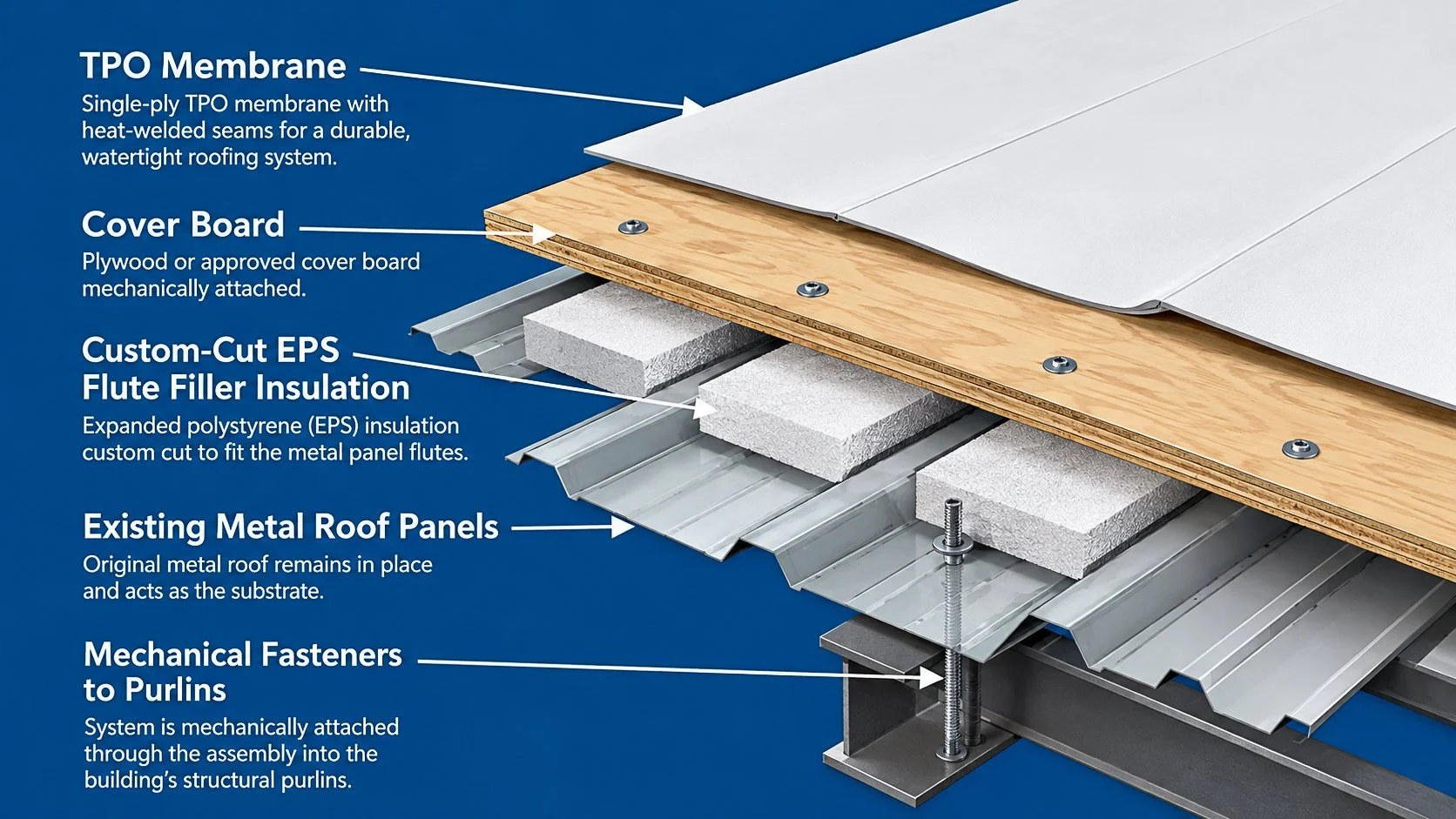
Illustration 1. Conceptual layers of a flute-filled TPO metal-roof recover. Not an installation specification.
How is the new roofing system installed?
Inspect the existing metal panels, attachment, structure, penetrations, and drainage. Correct deficiencies before covering them.
Fit approved flute-fill insulation snugly between the metal ribs to support the layers above.
Install the approved insulation and/or cover board to create the required substrate.
Secure the roof assembly using the manufacturer-approved fastening or adhesion method, including attachment to purlins where required.
Install the TPO membrane, hot-air weld the seams, and properly flash edges, penetrations, curbs, and transitions.
Perform required seam checks and final quality-control inspections.
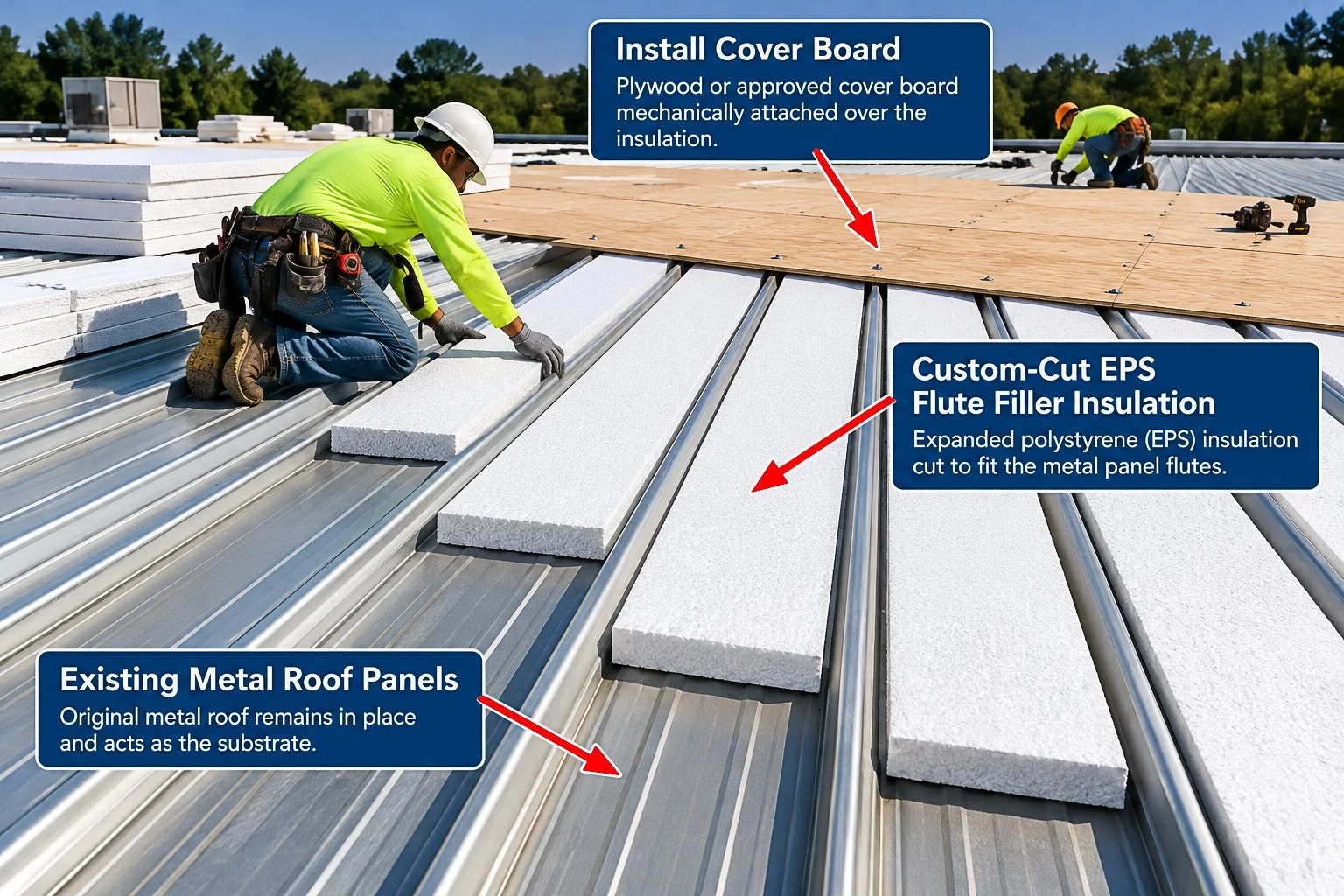
Illustration 2. Workers positioning flute-fill insulation. AI-generated educational illustration; not a photograph of an EMG project.
Why might TPO be a better investment than another coating?
A properly designed TPO recover provides a new waterproofing layer rather than relying solely on the existing metal panel seams and exposed fasteners. The flute fill and additional insulation can improve the roof assembly’s thermal performance. A reflective white membrane may also help reduce solar heat gain in appropriate climates and buildings.
Recovering a suitable roof can reduce demolition and disruption compared with a full tear-off. That benefit depends on moisture conditions, structural capacity, local code, existing roof layers, and manufacturer approval. A recover is not automatically cheaper, and it does not make damaged structural members safe.
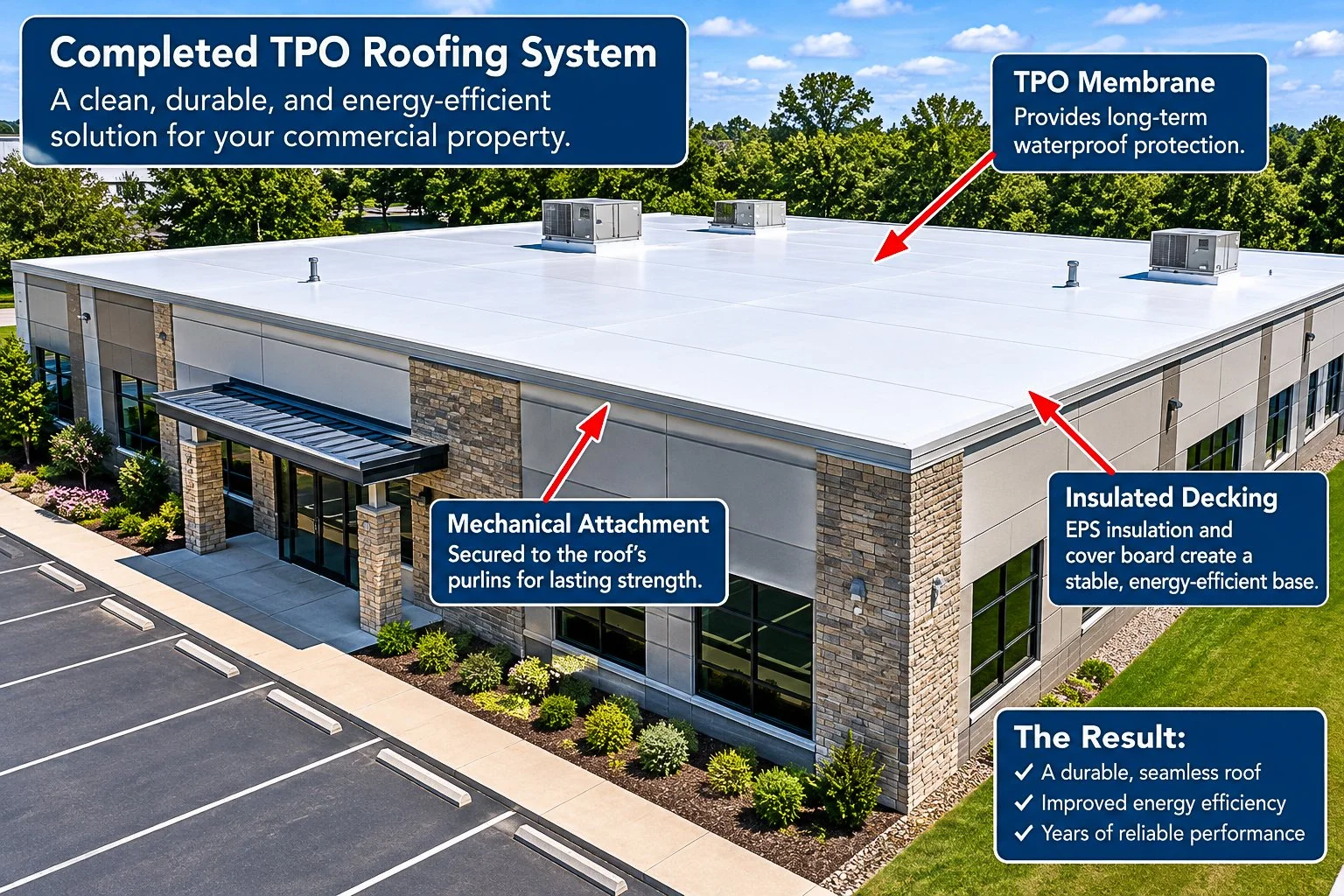
Illustration 3. Conceptual finished commercial TPO roof. AI-generated; not an EMG project photograph.
What about cost?
In some projects, the price of a properly specified coating restoration may be closer to a flute-filled TPO recover than an owner expects. That is a field observation, not a universal pricing rule. Coating preparation, rust treatment, seam repairs, insulation, access, tear-off requirements, and the selected membrane system can change the comparison substantially.
A useful estimate should explain what problems each proposal actually solves—not just show two prices. Owners should ask about expected maintenance, manufacturer warranty eligibility, drainage work, and what happens if existing defects continue beneath the new surface.
Questions to ask before approving either option
Where are the leaks coming from, and how will those causes be corrected?
Is there active corrosion, wet insulation, or damage that makes a recover unsuitable?
Does the roof drain properly, and is the proposed system approved for its conditions?
What substrate, insulation, attachment, and flashing details will be used?
What do the written warranty terms actually cover?
The bottom line
A roof coating can be a sound restoration choice when the existing roof is suitable and properly prepared. But on a metal roof with persistent seam failures, corrosion, or repeated leaks, a flute-filled TPO recover may deserve serious consideration. The best recommendation begins with a thorough inspection—not with a one-size-fits-all sales pitch.
EMG Building Solutions helps commercial property owners evaluate roofing conditions and understand practical repair and recover options. An assessment can help determine whether a coating, targeted repairs, a recover system, or full replacement is the appropriate next step.
Industry references and further reading
GAF — EverGuard Metal Retrofit Guide — https://documents.gaf.com/installation-instructions-%26-guides/guide__metal_retrofit_in_commercial_lowslope_roof_assemblies.pdf
Carlisle SynTec — Flute Fill Options for Metal Retrofit Projects — https://www.carlislesyntec.com/en/Resources/Media/Blog-Landing-Page/TecTopics/2020/08/10/Flute-Fill-Options-for-Metal-Retrofit-Projects
Roof Coatings Manufacturers Association — FAQs — https://www.roofcoatings.org/faqs/
National Roofing Contractors Association — 2026 Roof Coatings Guidelines announcement — https://www.nrca.net/RoofingNews/nrca%20offers%20updated%20guidelines%20for%20roof%20coatings.7%2014%202026.13404/details/story
ENERGY STAR — Cool Roofs — https://www.energystar.gov/products/cool-roofs
